


Testing Technology Automotive
Our core competence
ABOUT US
Electronics in vehicles require comprehensive inspection to ensure reliable operation. Kufferath Group provides testing technology for precise verification of automotive electronics. Test results confirm system functionality.
Solutions are developed for automotive applications; additional sectors are addressed as specified. For further information on automotive inspection technology, select the relevant link in the provided list.
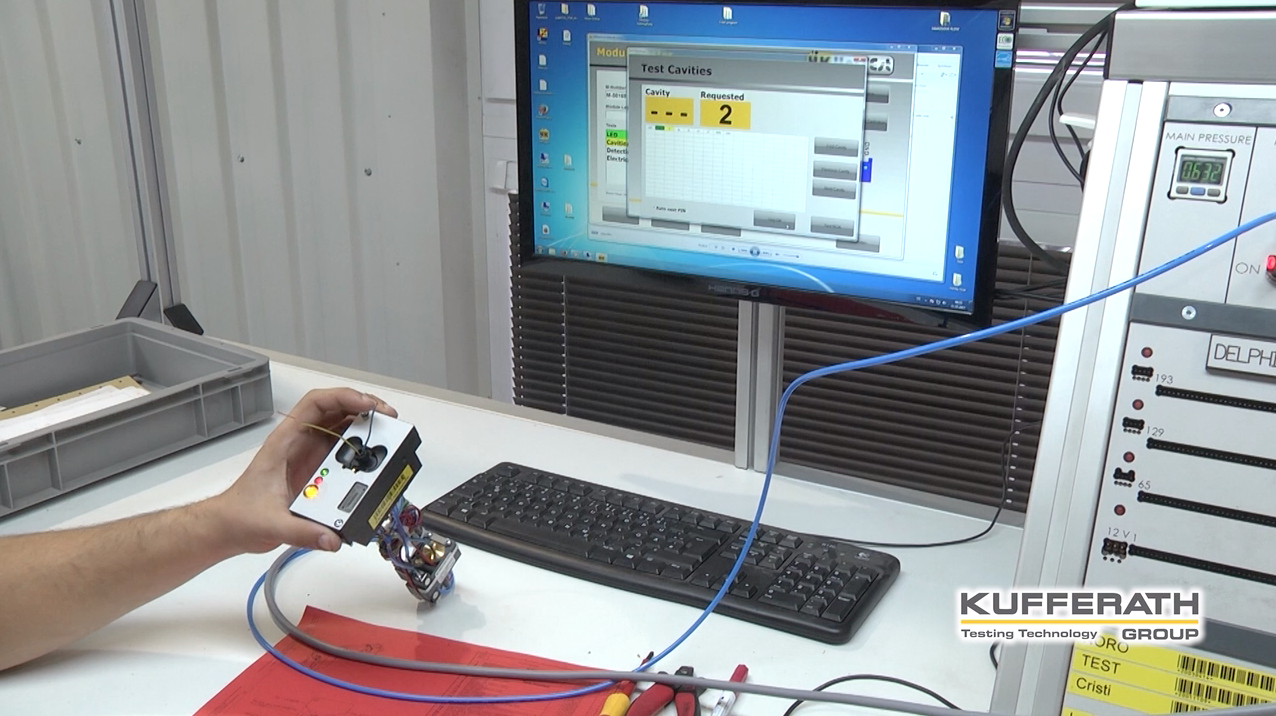
Testing for Automotive and Beyond
Electronics play an increasingly important role in everyday applications, particularly in vehicles. Automotive electronic systems support daily driving situations by performing a wide range of functions and contributing to vehicle safety. In addition to lighting, air-conditioning, locking systems, and instruments, modern vehicles rely on electronic control units for engine management, transmission control, ESP, ASR, ABS, and diagnostic functions that monitor system status and report faults.
As electronic systems continue to replace mechanical components, vehicle technology has evolved accordingly. The traditional role of the car mechanic has largely been supplemented by the car mechatronics technician, reflecting the integration of mechanical, electrical, and electronic systems. This development is also evident in vehicle wiring complexity: a vehicle from the 1950s typically contained a single cable harness with nine conductors and a total length of approximately four metres, whereas a modern mid-range vehicle contains several kilometres of cable with thousands of conductors and several hundred connectors.
Driving safety, emission behaviour, and fuel consumption are among the factors that require continuous communication between on-board electronics and control units.
To ensure correct operation, all electronic components are comprehensively tested prior to installation. This applies to complete cable harnesses as well as individual electronic components, regardless of size. Pre-installation testing is required to verify flawless functionality and to help avoid unnecessary recalls. As cable harnesses are manufactured entirely by manual processes, inspection is essential to detect potential assembly errors.
In mid-range vehicles, the fully assembled cable harness, including all connectors, is tested in a single test procedure using Kufferath Group test systems. This approach supports efficient and cost-effective inspection. The inspection technology verifies correct functionality or reliably identifies faults so that defective components can be removed from the production process.
Inspection requirements are not limited to the automotive industry. Cables and electronic modules must also operate reliably in mechanical engineering, plant engineering, medical technology, and aerospace applications. Based on this experience and supported by an international network of qualified specialists, Kufferath Group develops inspection solutions tailored to individual customer requirements across these industries.
Test Benches
Test panels and test benches form the structural basis of every test system. Test modules, test point cards, cable testers, control PCs, testing software, and the test bench itself are combined to create a complete test unit.
The test bench, as the core element of the system, is configured according to the specific test task and the design of the workpiece under test. Dimensions, geometry, and equipment are defined by the applicable technical and operational requirements.
Test benches are designed according to a modular principle, allowing systems to be expanded or reduced as requirements change. They can also be used to extend existing test installations or to integrate components from other manufacturers.
Designs follow current technical standards and ergonomic principles, with a focus on extensibility, measurement accuracy, and consistent test quality.
Modules
Test modules provide the interface between the workpiece under test and the test system.
Test benches and panels are generally based on three standard formats (50×50 mm, 50×100 mm, and 100×100 mm). Adaptation to alternative or customised formats is also supported and implemented according to application requirements.
Test modules are adapted to the specific test object and enable the following verifications, including parallel execution:
- Functional verification
- Position and connection verification
- Correct plug assembly
- Tightness testing
- Detection of defective connections
- Through-connection testing
- Verification of correct plug usage, including colour recognition and differentiation of similar plugs
After a successful test, the workpiece is removed either automatically or via operator input. Test results are output, for example as a printed label, and stored for documentation.
Test modules are designed to maintain consistent test reliability over a high number of test cycles. Repeated insertion and removal of test plugs result in minimal wear, supporting long service life, stable performance, and reliable operation with user-oriented handling.
HK UniTEst
The HK UniTEst system is a modular test platform designed for universal application.
System configuration follows a modular principle and is adapted to specific customer requirements. Hardware and software components are selected based on the defined test scope so that only required elements are implemented. The system supports subsequent expansion to accommodate future requirements. An intuitive user interface enables operation without extensive training.
HK UniTEst components can be integrated into existing test systems, including installations from other manufacturers. Technical support and service are provided independently of the system environment in which the solution is deployed.
Wire Harness Solutions
A comprehensive portfolio of tools to assist in manufacturing and inspection of harnesses at different steps of the process. The in-house R&D department is responsible for keeping products up-to-date, constantly implementing improvements and adapting systems with the latest technologies.
Teamwork between Development and Sales allows us to anticipate and define new products according to market needs. Our close and trusting relationships with customers enable us to increase our expertise and reflect it in our product portfolio—a win-win situation.
System Components
System components such as adapters, testers, software, assembly equipment, and related support services are available either as complete systems or as individual elements.
Modules are designed to combine into a complete test unit, forming an integrated system architecture.
Individual components can also be integrated into existing test installations. Software and testers are compatible with established test benches, and adaptation to existing interfaces is supported as part of system integration.